Build a REAL House Co-op Building Guide
Split the dig-to-tiles loop, finish faster with friends, and keep mastery XP fair.
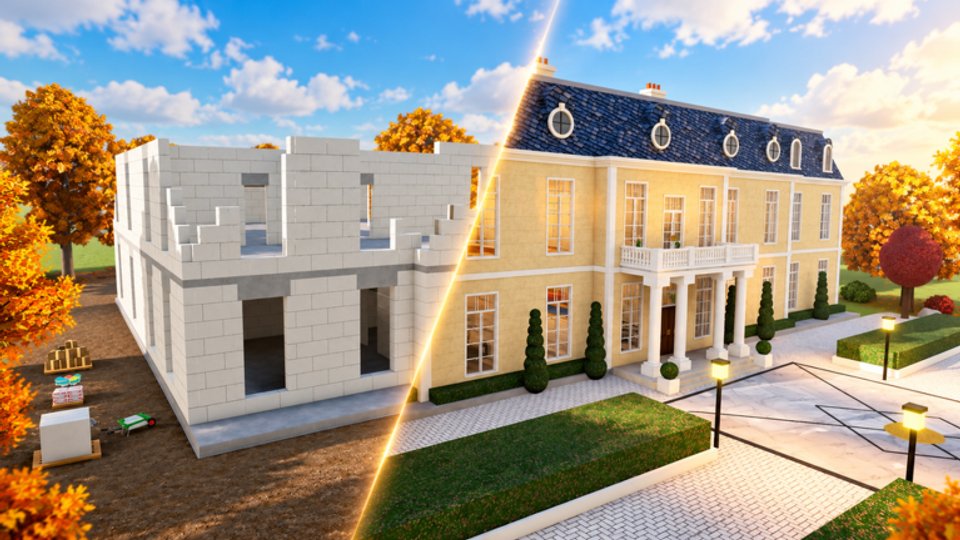
Build a REAL House supports co-op so friends can raise the same house together and finish faster than a solo grind. Co-op shines on Mansion, Riviera Villa, Sunset, and Estate — but bad co-op is slower than solo because four people dig the same corner. This guide covers roles, communication, stage splitting, etiquette, and how to keep Tool Mastery fair.
Find groups via the Players hub, then use Speed Building when your team wants leaderboard times instead of casual builds.
Why co-op works here
The build loop is embarrassingly parallel:
- Diggers can own opposite pit lanes.
- One player can specialize in pour quality (and the E handprint moment).
- Wall crews can split perimeter vs interior.
- Finishers can pipeline plaster → paint → tiles without idle time.
The loop itself stays identical (How to Build). Co-op only changes who holds which tool when.
Pre-build setup (two minutes)
- Agree which house you are finishing — do not “see what happens” on Estate.
- Confirm everyone knows Click/hold, F, Tab, E (Controls).
- Assign roles before the first dig scoop.
- Decide who owns the handprint this run.
- Claim any Codes so the whole party starts boosted.
Recommended roles
Duo (most common)
| Player | Early | Mid | Late |
|---|---|---|---|
| A | Dig lanes 1 | Walls long runs | Plaster |
| B | Dig lanes 2 + treasures | Roof + corners | Paint + tiles |
Pour lead: whoever has stronger pour mastery. Handprint: rotate each house.
Trio
- Digger — pit + treasures.
- Structure — pour assist, walls, roof.
- Finish — plaster, paint, tiles; stays ready as soon as roof seals.
Squad (4+)
- Two diggers on opposite corners.
- One pour/structure lead.
- One finish lead.
- Extra players pair on walls or clear missed panels as floaters — floaters need callouts or they create chaos.
Stage-by-stage split
Dig
Split the footprint into lanes or quadrants. Call “lane clear” so nobody re-digs finished dirt. Treasures go to a shared gem plan — discuss spends after the house, not mid-scoop fights (Treasures & Gems).
Concrete
One pour lead holds consistency; others spot thin patches or prep wall tools. When wet, the designated player presses E for the handprint. Do not stamp over each other.
Walls & roof
Clockwise ownership beats random stacking. “I own north wall” is a full sentence that saves minutes. Roof: one player sweeps panels while another spot-checks holes from a high camera.
Plaster → paint → tiles
Pipeline, do not pile. If three people plaster the same face, you idle later. Finish lead calls when plaster is good enough for paint. Tiles last — protect edges.
Communication that matters
Useful calls:
- “Pit 80% — treasures left SE.”
- “Pour thin at west edge.”
- “Roof hole center — I got it.”
- “Plaster done south — start paint.”
- “Tab break 20 seconds after tiles.”
Useless calls:
- “Hurry.” (Says nothing about which stage.)
- “Wrong tool” without naming who.
- Spam emotes during pour.
Voice is best; clean text macros work if everyone reads chat.
Etiquette rules
- Do not grief stages — ripping unfinished work for “funny” wastes trust.
- Rotate juicy moments — handprints, final tile, inspect flex (F) can be shared across nights.
- Share finish XP — if the same friend always paints, their plaster mastery stays Bronze forever (Tool Mastery).
- Ask before huge gem spends if you are pooling loot philosophy.
- Keep hostility off the site — random kick energy ruins Estate nights.
- Be honest about skill — new players should learn on House/Pool with the group, not get dropped cold onto Estate.
Mastery fairness
Co-op can accidentally specialize everyone into one tool forever. Healthy teams:
- Swap structure vs finish each house.
- Let newer players dig and place a wall segment.
- Run one “everyone finishes” House as a warm-up.
Your Rainbow flex means less if three teammates cannot plaster.
Co-op for learning vs co-op for speed
Learning session: slower calls, role rotation, pause for Tab teaching, maybe replay Pool.
Speed session: fixed roles, minimal chatter, pre-upgraded tools, route from Speed Building.
Do not mix goals mid-build. Say which night it is.
Troubleshooting co-op fails
| Symptom | Cause | Fix |
|---|---|---|
| Slower than solo | Everyone on same task | Re-assign lanes/roles |
| Stage soft-locked | Skipped roof/plaster | Return to stage order |
| Gem drama | Unclear loot rules | Decide before dig |
| One burned-out player | Same role three Estates | Rotate |
| Missed handprint | Nobody assigned | Assign during setup |
Sample Estate night agenda
- Meet on Players or friends list; confirm Estate.
- Codes + notebook upgrades for bottlenecks.
- Duo/trio roles locked.
- Dig quadrants → pour + handprint → walls/roof → finish pipeline.
- Group screenshot with F inspects.
- Short Tab review: what tool blocked the team.
- Optional second house with swapped finish lead.
Co-op is the intended comfort mode for late houses when communication is sharp. Build together on purpose — not as four solos sharing a plot.
Frequently Asked Questions
Quick answers to the most common questions.
Does Build a REAL House support co-op?
Yes. You can build with friends, split stages, and finish faster when roles are clear.
How should two players split the work?
Split dig lanes, pick one pour lead, divide walls/roof, then pipeline plaster into paint and tiles.
Who gets the handprint in co-op?
Assign it before the pour. Rotate each house so everyone gets the E moment over time.
Why is our co-op slower than solo?
Usually everyone is stacking the same stage. Re-assign lanes and stop triple-plastering one wall.